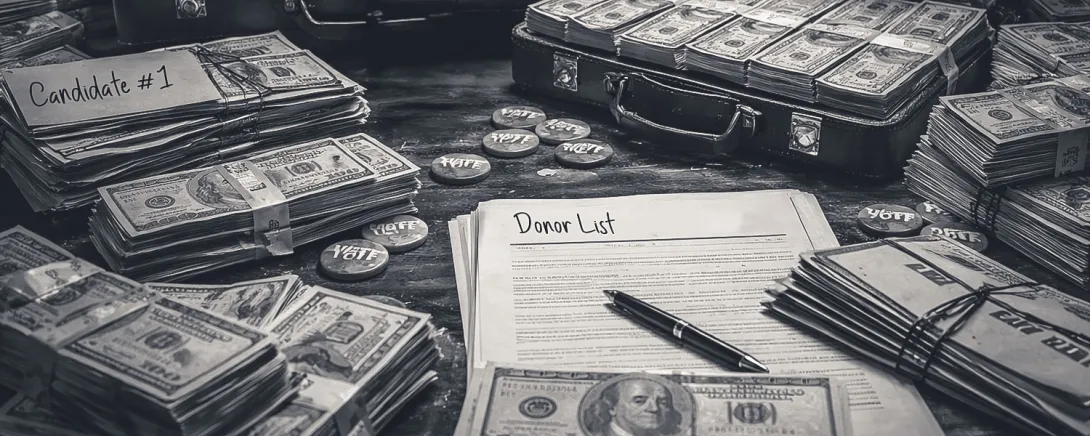
When it comes to campaign finance, the United States truly stands alone. Money plays a role in politics everywhere, but America’s system is shaped by the sheer volume of private fundraising and the relatively few restrictions on political spending. This became especially true after the 2010 Supreme Court decision in Citizens United v. FEC. The ruling treated political spending as a form of free speech and allowed corporations, unions, and wealthy individuals to spend unlimited amounts as long as they do not coordinate directly with candidates.
The Rise of Super PACs and the Surge of Outside Money
After Citizens United, Super PACs began to play a major role in American elections. These independent political committees can accept unlimited donations from corporations, unions, or individuals. They use these funds to influence elections, provided they do not coordinate with candidates’ campaigns. The result has been a dramatic increase in outside money shaping American politics. In the 2020 election cycle, federal candidates and committees raised between $14 and $15 billion. This level of spending is unmatched among advanced democracies. In most other countries, campaigns are shorter, spending is capped, and public subsidies are more common.
Global Norms Emphasize Limits and Transparency
Most democracies around the world have introduced stricter rules for political money than the United States. About 22 percent of countries completely ban corporate donations to candidates or parties. In the U.S., direct corporate contributions to candidates are illegal, but corporations can still fund Super PACs to influence elections indirectly. Even where large private or corporate donations are allowed, many countries set strict limits. There is no overall cap in the United States on the amount an individual or corporation can spend independently to impact an election.
Transparency is another area where the U.S. is often seen as falling short. Most OECD countries require donor identities to be made public. However, the U.S. system has loopholes such as certain nonprofit organizations and some Super PACs that allow for “dark money,” where the real source of funding remains hidden. Many European democracies go further by completely banning anonymous donations. While foreign donations are illegal in most countries, including the U.S., the biggest influence in American politics comes from domestic donors with deep pockets.
Public Funding and Spending Controls Aim to Level the Playing Field
Public financing provides another distinction between the U.S. and many other democracies. Nearly 70 percent of countries offer direct public funding to political parties or candidates, and even more provide free media airtime or other indirect campaign support. The goal is to reduce reliance on wealthy donors and ensure a fairer playing field. The United States does have a public financing option for presidential campaigns, but most major candidates no longer use it because they can raise more money privately. With no overall caps on campaign spending, American elections rely on private money to an extent rarely seen elsewhere.
The U.S. system has loopholes such as certain nonprofit organizations and some Super PACs that allow for “dark money,” where the real source of funding remains hidden.
The Impact on Democratic Integrity
It is important to consider why these differences matter. Analysts and organizations like the OECD caution that excessive private financing can tilt policy outcomes in favor of large donors, which threatens the fairness of democracy itself. There are well-documented cases, in the U.S. and abroad, where major contributors have gained favorable contracts or regulatory breaks, a situation sometimes called “policy capture.” The perception or reality that money can buy influence undermines public trust in democracy. While some scholars debate how much money actually impacts outcomes, the vast sums and lack of transparency in the U.S. continue to fuel concerns about corruption and unequal access.
Finding the Right Balance
To sum up, the U.S. campaign finance model allows more private money and fewer restrictions than most other democracies. This leads to unprecedented spending and ongoing debates about the influence of money in politics. Other countries generally try to balance free speech with equality and transparency using regulation. The American system stands out, and the conversation about how best to protect democratic integrity continues.